
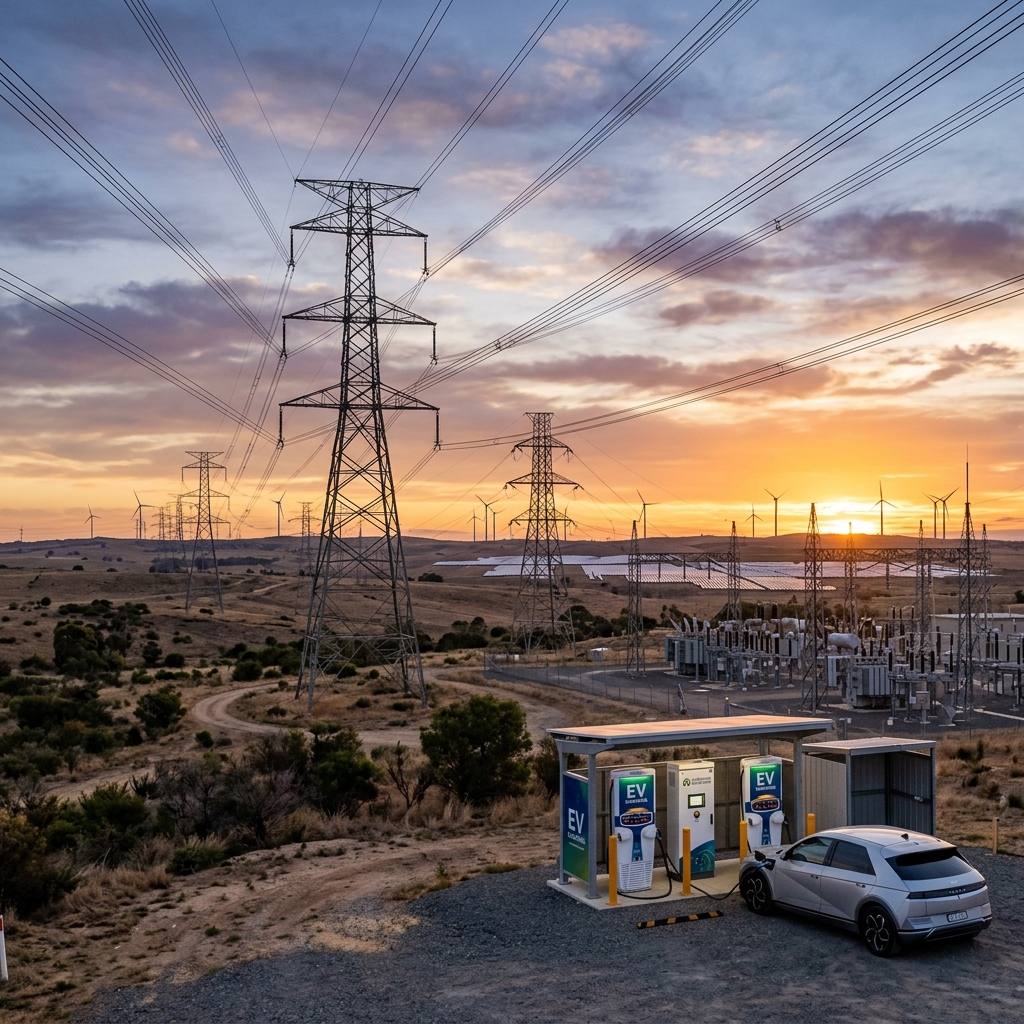

The Illusion of Progress: Generation Won, But Delivery is Failing
For over a decade, Australia focused on the supply side — and it worked. Renewable generation in the National Electricity Market (NEM) surged from 15% in 2015 to a record 46.5% in 2026. The Cheaper Home Batteries Program quietly delivered 10.7 GWh of distributed storage. Thousands of megawatts of utility-scale solar and wind are online.
On paper, we are a renewable superpower. But for the commercial developer, the industrial property owner, and the institutional investor, the real story is different.
The weakest link is no longer generation capacity — it is the intelligence to connect, manage, and monetise demand at the grid edge.
Australia didn’t solve the electrification puzzle — it solved the generation puzzle. The next war is being fought at the edge of the grid, and most DNSPs are flying blind.
The Infrastructure Barrier: Why Grid Visibility Matters More Than Capacity
Electricity networks were engineered for a static world — one-directional flow from large plants to passive consumers. That model has collapsed. Today, EV fleets, MW-scale BESS installations, data centre loads, and distributed solar are pulsing demand simultaneously.
Distribution Network Service Providers (DNSPs) often lack the real-time low-voltage visibility and predictive capability to manage this dynamic load. The default response to large-scale commercial electrification projects is hesitation, inflated connection costs, or outright blockage. For the investor, this creates a Grid Risk premium that can destroy a project’s internal rate of return before the first foundation is poured.
Government policy remains fixated on capacity additions — Gigawatts of nameplate generation — while ignoring the Intelligence Gap. Adding generation to a blind grid is like adding lanes to a highway without traffic signals: it does not increase flow; it increases congestion.
The Elsons Ecosystem: Engineering a Bridge Across the Intelligence Gap
In an infrastructure environment that is structurally unfriendly to expansion, off-the-shelf installation models fail. You cannot buy your way through systemic friction with cheaper panels or faster inverters. You need an architectural bridge — a strategic ecosystem engineered to navigate grid uncertainty and convert it into financial certainty.
At ELSONS, we apply the EPM Framework — Engineering, Product Solution, and Project Management — to deliver what we call Institutional Bankability. Our ecosystem is designed not just to connect hardware, but to intelligently orchestrate generation, storage, and load management as a unified, revenue-generating asset.
1. Technical Load Profiling
We map your site’s generation potential, consumption patterns, and connection constraints before engaging the DNSP. High-fidelity data replaces guesswork, turning your project from a “grid burden” into a “grid asset.” This is the difference between an approved connection and a stalled application.
2. Embedded Energy Infrastructure (EEI)
We combine MW-scale Solar PV with intelligent BESS to create a private energy web. This decouples critical loads from grid volatility while enabling VPP participation — transforming the “weakest link” into a revenue stream through AI-driven energy arbitrage.
3. VPP & Carbon Strategy
Through Virtual Power Plant integration and Carbon Trading solutions, your energy infrastructure shifts from a cost centre to a profit centre. Every megawatt-hour stored and dispatched intelligently generates revenue — turning the electrification challenge into a competitive advantage.
The Architecture of Selection: Why Hardware Alone Won’t Save You
Most providers sell you a product. At ELSONS, we deliver an asset. The distinction lies in how we select, integrate, and guarantee every component across the lifecycle of your project.
Our ecosystem partners — Astronergy, JA Solar, Sungrow Power, and SolaX — have passed a rigorous four-pillar filter:
- Global Scale & Presence — Balance sheets and production capacity that guarantee lifelong support and spare-part availability across decades.
- Localised Support Level — Verified service infrastructure and response-time SLAs that eliminate operational downtime.
- Market-Trend Technology — Leadership in n-type TOPCon, intelligent BESS, and VPP readiness ensures your asset does not become obsolete before its ROI is realised.
- ESG & Due Diligence — Clean supply chains and manufacturer ESG standards that satisfy institutional green fund requirements.
The Power of Integration
PV generation + BESS intelligence + VPP arbitrage + Carbon trading = a single, symbiotic energy loop that maximises financial yield and eliminates grid friction.
The Bottom Line: Intelligence is the New Capacity
Australia has the sun, the wind, and the capital. What it lacks is the intelligence to connect them at the grid edge. Policy will eventually catch up — but you cannot afford to wait.
The developers, property owners, and corporations that succeed in this environment will be the ones who stop buying components and start engineering ecosystems.
At ELSONS, we bridge the gap between complex energy technology and institutional reliability. We don’t just install systems — we engineer certainty.
This analysis was informed by “Age of Electrification Exposing Australia’s Weakest Link” (pv magazine Australia, 1 June 2026). The views, strategic conclusions, and ecosystem framework presented are those of ELSONS.
Is Grid Risk Hurting Your Project’s IRR?
Don’t let infrastructure friction kill your energy investment. Let ELSONS map the path to a bankable, grid-ready asset.
