
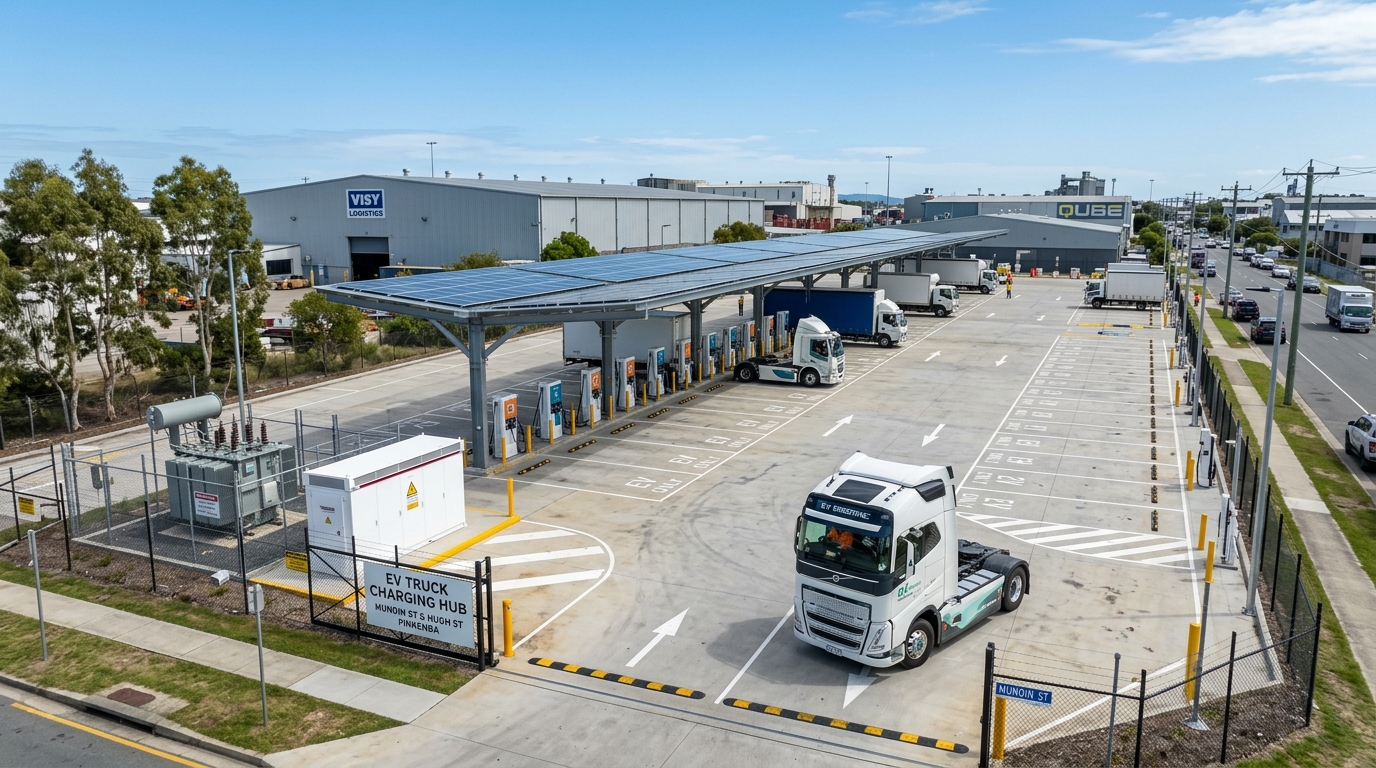
Source: pv magazine Australia — “Electric truck fleet leads the charge for cleaner heavy haulage”
The Headline
Australia’s largest private logistics company — Linfox — is deploying 26 battery-electric prime movers across Melbourne, Brisbane and Adelaide, backed by $19.63 million from ARENA’s Driving the Nation program. These trucks cover roughly 500 km per day on heavy-hauling freight routes, displacing diesel on food, beverage and integrated rail distribution.
It’s a milestone for Australian logistics. But the real question isn’t whether the trucks work — it’s whether the energy infrastructure can keep up.
Why This Matters for the Future of Heavy Haulage Electrification
This isn’t a trial or a handful of test vehicles. This is commercial-scale deployment on Australia’s busiest urban freight corridors. A few observations:
1. Energy Security is the Underappreciated Driver
Minister Chris Bowen captured it well: “Linfox has taken a huge step to secure its energy security and consistently low running costs.”
Diesel prices are volatile — tied to global geopolitics, refining margins and supply chain fragility (remember the AdBlue shortage?). Electric fleets decouple operating costs from oil markets. For a 70-year-old company employing 24,000 people, that’s a structural hedge, not just a green label.
2. The Infrastructure Stack is Right — But Not Yet Scaled
Linfox’s project covers fast chargers and onsite solar. That’s the right model: generate, store, consume. But onsite depot charging works for one fleet at one location. Scale that across an entire city — multiple operators, multiple depots, multiple vehicle classes — and the challenge multiplies.
Australia doesn’t yet have the dedicated, high-capacity charging stations purpose-built for heavy-haul logistics. Depot trickle-charging breaks down under multi-shift operations. Public fast-chargers designed for passenger EVs can’t handle prime movers. And without a coordinated energy ecosystem — renewable generation, firm battery storage and intelligent load management — the grid can’t absorb dozens of megawatts of new freight demand without costly upgrades.
3. Noise Reduction is a Real Community Dividend
As MP Tim Watts noted: “Anyone who lives near a busy freight route knows the noise. Electric trucks are significantly quieter.”
That’s a tangible quality-of-life improvement for suburbs adjacent to major freight corridors. It also builds community and political goodwill — making future EV-friendly policy easier to advance.
4. $70M CEFC Backing for Domestic Manufacturing
An additional $70 million from the Clean Energy Finance Corporation is helping Volvo’s Queensland truck manufacturing plant scale heavy EV production — creating skilled jobs and local supply chain resilience rather than relying solely on imported hardware.
The Elsons View: Trucks Are Ready — The Charging Ecosystem Isn’t
At ELSONS, we believe the transition to electric heavy haulage will only succeed when the energy infrastructure ecosystem is built to support it at commercial scale.
You can put the best BEV prime movers on the road. Without high-capacity charging stations backed by reliable, commercially viable energy supply, they’re just expensive parked assets.
The real challenge — and opportunity — is energy deployment at scale: building the charging infrastructure, integrating it with renewable generation, managing peak demand and making the unit economics work for fleet operators — not just for early adopters, but for the mass market.
That’s exactly what ELSONS is building.
We are in active development of what will be one of the first large-scale charging stations purpose-built for heavy commercial fleets. It’s not just a set of chargers in a depot. It’s a complete energy ecosystem:
- On-site renewable generation
- Battery energy storage to flatten demand peaks
- Smart load management across multiple fleet operators
- A commercial model that makes the unit economics work
Linfox proves that demand-side readiness is real. ELSONS is building the supply side.
What This Signals for the Australian Energy & Logistics Market
| Signal | Implication |
| ARENA funding for heavy BEVs is active and expanding | Grant-writing for logistics electrification is worth the investment |
| Linfox’s scale validates the business case | Tier 2 and 3 operators will follow — but they need charging infrastructure first |
| Solar + charging + fleet = integrated energy model | Energy infrastructure providers become the critical enabler |
| Volvo QLD plant is ramping EV production | Local servicing, parts and conversion capability is being built |
| No dedicated heavy-haul charging network exists yet | First-mover advantage for infrastructure developers like ELSONS |
The Risk: Infrastructure Gaps for Regional Routes
500 km/day works for metro and semi-urban routes with return-to-base charging. For long-haul regional or remote routes, battery-electric prime movers still face range and charging infrastructure gaps. Hydrogen isn’t dead yet for those applications.
Without a public charging network for heavy vehicles, even the best metro deployment hits a wall. That’s the gap ELSONS is closing, starting with high-density freight corridors.
Verdict
8.5 / 10 — genuinely impactful, commercially grounded and well-structured as a fleet play.
Linfox has done the math: lower fuel costs, energy security, government co-funding and operational resilience. The Driving the Nation program is working exactly as intended — de-risking adoption at scale so the private sector can run with it.
But the next chapter of this story isn’t about trucks. It’s about the charging ecosystem that makes mass deployment possible. And that’s where ELSONS is building the answer.
Follow ELSONS for the Latest on Fleet Electrification
Stay across the latest developments in Australia’s energy transition — from heavy haulage electrification to commercial-scale charging infrastructure and grid resilience strategies. Follow ELSONS on social media for regular analysis, market intelligence and project updates:
Ready to Build Your Electric Fleet Charging Strategy?
If your logistics operation is evaluating the transition to battery-electric heavy vehicles — or if you’re planning charging infrastructure for commercial fleets — ELSONS can help. From feasibility studies and energy modelling through to project delivery and commissioning, our EPM Framework delivers the infrastructure backbone your fleet electrification depends on.
